"Dear Valued Customer." Few phrases signal generic marketing faster. When a message is written for everyone, it lands with no one — it gets skimmed, ignored, or unsubscribed. The marketing that actually drives sales feels like it was written for the person reading it.
The catch is that you can't personalize for one customer at a time — not at any meaningful scale. What you can do is recognize that your customers aren't a single undifferentiated mass. They naturally fall into a handful of distinct groups, each with its own behavior, motivations, and value to your business. Speak to each group on its own terms, and ordinary marketing starts to feel personal.
This post is about discovering those groups — your customer segments — and turning them into marketing that resonates. And because doing it by hand is tedious, I'll show you a free tool I built that does the heavy lifting on your own computer.
"Everyone" Is Not Your Audience
Picture two customers. One has bought from you a dozen times this year and spends well above average. The other bought once, six months ago, during a promotion, and hasn't returned. Should they get the same email? The same offer? Obviously not — and yet most small businesses send both of them the identical monthly blast, because segmenting feels like something only big companies with data teams can do.
It isn't. The information you need is already sitting in your sales history. Every purchase is a signal about who a customer is and what they want. Grouped correctly, those signals tell you precisely which message and which offer will land for each kind of customer.
Personalization doesn't require knowing everything about one customer. It requires knowing the few things that matter about each group — and acting on them.
What a Customer Segment Actually Is
A customer segment is simply a group of customers who behave similarly enough that the same marketing approach works for all of them. The most useful segments for a small business are built from behavior — how recently someone bought, how often they buy, how much they spend, and what they buy — because behavior predicts what someone will do next far better than age or zip code ever could.
When you group customers by behavior, distinct personalities emerge: the loyal regulars, the big spenders, the bargain hunters, the slipping-away former favorites. Each one responds to a different message. The job is to find these groups in your own data and then tailor your marketing to fit.
The Segments Hiding in Your Data — and How to Personalize for Each
Most small businesses, once they look, find some version of these groups. For each, the data signal tells you who they are and the personalization play tells you what to do.
VIPs / Champions
What you see in the data: Bought recently, buy often, spend the most — frequently 15–20% of customers driving the majority of revenue.
How to personalize: Make them feel like insiders, not targets. Early access, a genuine thank-you, loyalty perks, referral asks. Avoid discounts — they already love you, and discounting trains them to wait for sales.
Steady Regulars
What you see in the data: Consistent, moderate purchases over time. Reliable but not top-tier spenders.
How to personalize: Nudge them upward. Personalized product recommendations based on what they already buy, bundles, and gentle upsells that increase average order value without feeling pushy.
At-Risk / Slipping Away
What you see in the data: Used to buy regularly, but recency is dropping — they haven't been back in a while.
How to personalize: Move fast with a specific, time-limited win-back offer. For your highest-value at-risk customers, a personal note outperforms any mass campaign. The longer you wait, the harder they are to recover.
One-Time Buyers
What you see in the data: Bought once and never returned — often acquired during a single promotion or event.
How to personalize: Focus entirely on earning the second purchase within the first 30–45 days. A short follow-up sequence centered on the value they already received, not a hard sell.
Discount-Driven
What you see in the data: Only purchase during sales; near-zero activity at full price.
How to personalize: Don't waste full-margin campaigns on them. Reserve your promotional messaging for this group specifically — and protect your margins by keeping those offers away from your VIPs.
Notice that each group needs a different message, a different offer, and sometimes a different channel. That's personalization at the segment level — and it's entirely achievable for a small business. The only real question is how to find these groups in your own data without spending a weekend wrestling with spreadsheets.
How to Actually Discover Your Segments
You could eyeball your customer list and sort by spend — and that's a fine start. But the moment you want to group customers across several behaviors at once (recency and frequency and spend and category), manual sorting breaks down. There are too many combinations to hold in your head.
This is exactly what clustering is for: letting the data group customers by similarity across many dimensions at once, surfacing natural segments you'd never spot by hand. It sounds technical, but you don't need to run the math yourself — the right tool does it for you and hands back labeled groups you can act on.
Free Tool
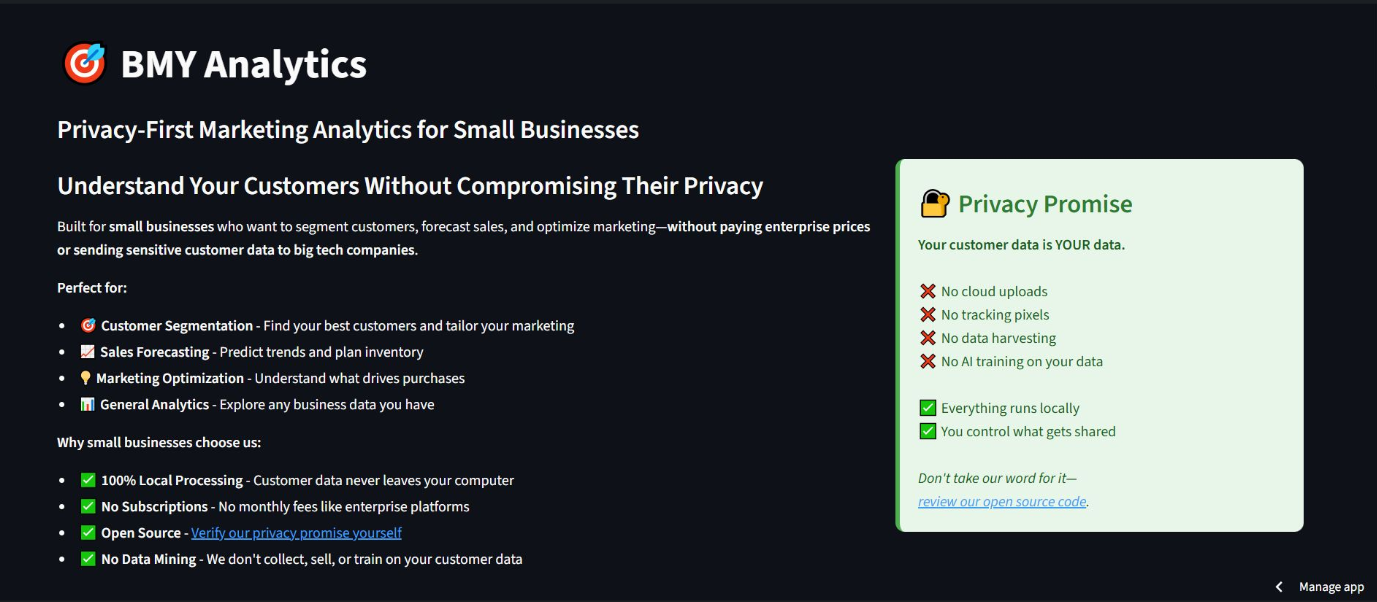
The BMY Analytics Segmentation Tool
I built a free web app that takes you from a raw customer or sales export to labeled segments — without sending your data anywhere. Upload a CSV or Excel file and it walks you through the whole workflow: cleaning, feature engineering, exploring who buys what and when, and automatically grouping customers into segments using K-Means clustering.
- Upload your data — customer lists and sales history (CSV / Excel)
- Clean it — remove duplicates, fix errors, handle missing values
- Engineer features — build the behavioral columns that matter (recency, frequency, spend)
- Understand your customers — see who buys what, when, and how often
- Find segments — automatically group customers (VIPs, at-risk, growth opportunities)
Honest scope: segmentation today runs on K-Means clustering, which works best with numeric behavioral data like recency, frequency, and spend. Sales forecasting is on the roadmap. Because it's open source, you can verify the privacy promise yourself.
Turning Segments Into Personalized Campaigns
Finding segments is only half the work — the value comes from acting on them. Once you have your groups, personalize across four levers:
- 1Message — speak to what each group cares about. VIPs hear gratitude and exclusivity; at-risk customers hear "we miss you"; one-timers hear "here's what to try next."
- 2Offer — match the incentive to the group. Discounts for the discount-driven, perks for VIPs, a low-friction second-purchase nudge for one-timers.
- 3Timing — reach people on their own cycle. Trigger an at-risk campaign at the moment recency crosses your threshold, not on a fixed monthly calendar.
- 4Channel — meet each group where it responds. A personal email or call for high-value at-risk customers; automated sequences for lower-value groups.
Start with one segment and one campaign. Win back your slipping VIPs, or earn the second purchase from recent one-timers. A single focused, personalized play will outperform months of "Dear Valued Customer" blasts.
Start This Week
Export the last 12 months of your sales data, run it through the tool, and look at the groups it surfaces. You'll almost certainly find a segment you've been ignoring — a cluster of high-value customers slipping away, or a wave of one-time buyers you never followed up with. That's your first personalized campaign, waiting to be written.
And if you'd rather have segmentation tuned to your specific business — connected to your systems, refreshed automatically, or extended with analysis K-Means can't do — that's exactly the kind of customer segmentation and analytics work I do with Hamilton, Ohio small businesses and e-commerce brands. The free tool gets you started; a custom engagement takes it further.


