Here's a number that should stop you in your tracks: in most small businesses, the top 20% of customers generate between 60% and 80% of total revenue. Read that again. A fifth of your customer base is responsible for the majority of your income — and most business owners have no idea which customers are in that group, let alone a strategy for protecting and growing that relationship.
That's the core problem customer segmentation solves. When you segment your customers — grouping them based on their purchasing behavior — you stop sending every customer the same generic message and start having the right conversation with the right person at the right time. The result is higher retention, lower marketing waste, and compounding revenue growth from the buyers who matter most.
This guide is built for small business owners in Hamilton, Ohio and beyond who want a practical, no-nonsense framework for segmentation — one you can implement this week without expensive software or a data team. By the end, you'll have a working segmentation model, a plan for each customer group, and a clear picture of where your revenue actually comes from.
What Customer Segmentation Actually Means
Customer segmentation is the practice of dividing your customer base into distinct groups based on shared characteristics — typically purchasing behavior, but also demographics, geography, or product preferences. Instead of marketing to "your customers" as a monolithic audience, you market to specific groups in ways that match exactly where each group is in their relationship with your business.
For a small business, segmentation doesn't need to be complicated. You don't need a CRM with machine-learning scoring or a data science team. What you need is a structured way of looking at who's buying from you, how often, and how much — and then acting differently toward each group. That's it.
The goal of customer segmentation isn't to build elaborate models. It's to answer one practical question: which customers deserve more of my attention, and what should I say to each group?
The 80/20 Reality: Why This Matters More Than Any Ad Campaign
The Pareto principle — the idea that roughly 80% of outcomes come from 20% of inputs — shows up with striking consistency in small business revenue data. Your top customers don't just spend more; they spend more often, they refer others, they leave reviews, and they're significantly cheaper to retain than a new customer is to acquire.
Studies consistently show that acquiring a new customer costs five to seven times more than retaining an existing one. And a customer who makes a second purchase is three times more likely to become a regular than someone who has only bought once. These numbers completely change the economics of how you should be spending your marketing budget.
When you treat all customers the same — running broad promotions, sending identical email blasts, giving the same discount to everyone — you're subsidizing your least valuable customers with budget that should be protecting and rewarding your best ones. Segmentation corrects that misallocation.
The Three Segments Every Small Business Should Know
Before building any model, get clear on the three fundamental customer groups that exist in every small business. Most sophisticated segmentation frameworks are just expansions of these three core categories.
Champions (Your VIPs)
Who: Customers who buy frequently, spent recently, and spend more than average
Signal: High recency, high frequency, high monetary value
Your move: Reward loyalty, offer early access, ask for referrals — protect this relationship above all else
At-Risk Customers
Who: Previously active buyers who have gone quiet — haven't purchased in 60–120 days
Signal: Good history but recency is dropping fast
Your move: Win-back campaign with a specific offer or personal outreach before they're gone for good
One-Time or Low-Value Buyers
Who: Bought once or twice, low spend, haven't returned
Signal: Low recency, low frequency, low monetary value
Your move: Second-purchase conversion sequence — a targeted offer focused on getting one more transaction
These three groups require completely different marketing approaches. A win-back campaign that works on at-risk customers is wasted on your VIPs (who don't need a discount — they already love you). A broad promotion aimed at one-timers may actually train your best customers to wait for sales. Segmentation prevents these expensive mistakes.
RFM Analysis: The Framework That Changes Everything
The most powerful and practical customer segmentation framework for small businesses is RFM analysis — scoring customers on three dimensions:
- Recency (R) — How recently did the customer make a purchase? A customer who bought last week is worth more than one who bought eight months ago, even if the older customer historically spent more.
- Frequency (F) — How often does the customer buy? A customer who visits monthly has a fundamentally different relationship with your business than one who visits once a year.
- Monetary Value (M) — How much does the customer spend in total? High monetary value, combined with high recency and frequency, identifies your true VIPs.
RFM was developed by direct mail marketers in the 1990s and has since become one of the most widely used and validated frameworks in customer analytics — precisely because it's simple, actionable, and requires nothing more than your transaction history. No algorithms, no black boxes. Just a spreadsheet and your sales data.
Step-by-Step: Build Your RFM Model in Google Sheets
Here's how to build a working RFM segmentation model in under an hour, using only Google Sheets and your existing customer data.
Step 1: Export Your Customer Transaction Data
Pull a report from your POS system, e-commerce platform (Shopify, WooCommerce, Square), or CRM that includes at minimum: customer name or ID, purchase date, and purchase amount. Export as a CSV. You want at least 12 months of history — 24 months is better for spotting behavioral trends.
Step 2: Create a Customer Summary Table
In a new sheet, create one row per customer with these columns:
Customer ID | Last Purchase Date | Days Since Last Purchase | Total Orders | Total SpentUse MAXIFS to find the most recent purchase date per customer, COUNTIFS for total orders, and SUMIFS for total spend. Google Sheets handles all three natively — no add-ons required.
Step 3: Score Each Customer 1–3 on R, F, and M
Divide each dimension into three equal thirds (tertiles) of your customer base and assign a score:
- R score: 3 = purchased within the last 30 days, 2 = 31–90 days, 1 = over 90 days (adjust these thresholds for your business's typical purchase cycle)
- F score: 3 = top third by order count, 2 = middle third, 1 = bottom third
- M score: 3 = top third by total spend, 2 = middle third, 1 = bottom third
Use PERCENTRANK or nested IF statements to automate the scoring. For Recency, lower days = higher score. For Frequency and Monetary, higher values = higher score.
Step 4: Calculate the Combined RFM Score
Add a column that concatenates the three scores into a single string — so a customer who scores 3 on Recency, 3 on Frequency, and 3 on Monetary gets a score of 333. A lapsed low-value customer might score 111.
=CONCATENATE(R_Score, F_Score, M_Score)Step 5: Assign Segment Labels
Map score ranges to your segment labels using an IFS formula or a lookup table:
- Champions: RFM scores of 333, 332, 323 — these are your VIPs
- Loyal Customers: scores of 322, 313, 312, 231 — high frequency, still engaged
- At-Risk: scores of 211, 212, 221 — bought well before but frequency is dropping
- Needs Attention: scores of 311, 312 — recent but low frequency — convert them before they slip
- Lost: scores of 111, 112, 121 — haven't been back in a long time, low value
Your first RFM model doesn't need to be perfect. A rough segmentation based on this framework will outperform no segmentation every single time. Build it, act on it, and refine it over the next quarter as you learn what each segment responds to.
What to Do With Each Segment — Specific Marketing Plays
The segmentation is only valuable if it changes how you act. Here's a playbook for each group:
Champions: Protect and Leverage the Relationship
- Send a personal thank-you — not a generic email, but a message that acknowledges their loyalty. For a Hamilton, Ohio brick-and-mortar, this can literally be a handwritten note or a personal phone call.
- Give early or exclusive access to new products, services, or events. VIPs should feel like insiders, not just another name on a mailing list.
- Ask for referrals. A satisfied VIP is your most cost-effective source of new high-quality customers. Make the ask specific: 'Do you know anyone else who could benefit from what we do?'
- Offer a loyalty reward — not a discount (which trains them to wait for sales) but an upgrade, a gift, or access to something exclusive.
At-Risk Customers: Move Fast
- Time is everything here. The longer a formerly active customer goes without engaging, the harder they are to win back. Set up a trigger at 60 days of inactivity.
- Send a win-back email with a concrete, time-limited offer: 'We haven't seen you in a while — here's 15% off your next visit, valid through [date].' Specificity converts better than vague promotions.
- For your highest-value at-risk customers, a personal outreach — a direct email or phone call — often recovers the relationship when a mass campaign wouldn't.
- Survey them. 'We noticed you haven't been back in a while — did something go wrong?' This both recovers customers and reveals operational issues you didn't know existed.
One-Time Buyers: Win the Second Purchase
- The window for converting a one-time buyer to a repeat customer is narrow — typically 30 to 45 days after the first purchase. After that, the probability of a second purchase drops sharply.
- Send a follow-up 7–10 days after the first purchase: a check-in, a related product recommendation, or a first-timer offer.
- Focus the message on the value they already got, not on getting them to spend more. 'How did you like [product]? Here's what customers who bought it also loved.' This is customer-centric rather than sales-first.
- Don't burn budget on elaborate campaigns for low-value one-timers. A simple two-email sequence is enough — if they don't convert, move on.
Beyond RFM: Adding Behavioral and Demographic Layers
Once your basic RFM segmentation is running, you can enrich it with additional dimensions that make your targeting even more precise.
Product or Service Preference
Identify which category of product or service each customer segment gravitates toward. A hardware store in Hamilton, Ohio might find that its VIP segment skews heavily toward professional contractors, while its one-time buyers came in for a single home improvement project. That insight completely changes the marketing message for each group.
Seasonality
Some customers are seasonal by nature — they buy before the holidays, at the start of summer, or when school starts. Segment these buyers separately so you're not marking them as "at-risk" when they haven't purchased in eight months — they're right on schedule. Understanding seasonal behavior prevents you from wasting win-back spend on customers who were always going to come back anyway.
Acquisition Channel
Where did each customer first find you? Customers who found you through Google search often behave differently than those who were referred by a friend or found you at a community event. If you have this data, it's worth tracking — because it tells you not just how to market to existing segments, but which acquisition channels bring in the highest-value customers. That's where you put more budget.
A Real-World Example: A Hamilton Retailer Discovers Its Revenue Is Hiding in Plain Sight
Consider a hypothetical home goods retailer in Hamilton's downtown corridor. They have roughly 1,200 customers in their system, run monthly promotions to the full list, and feel like their marketing isn't working. Response rates are low. The promotions barely move the needle. They're spending on ads and seeing inconsistent results.
A basic RFM analysis of their 18-month transaction history reveals the following:
- 218 customers (18% of the list) are responsible for 71% of total revenue — a textbook 80/20 split
- 64 of those VIP customers haven't purchased in over 75 days — they're slipping toward the at-risk category with no intervention in place
- 510 customers bought once and never returned — the majority came in during a single promotional event
- The monthly mass promotions are going to all 1,200 customers, including 310 who last purchased over a year ago
With this picture, the strategy becomes obvious. Stop broadcasting to 1,200 people. Launch an immediate at-risk campaign for the 64 lapsing VIPs — personal outreach, specific offer, human tone. Create a VIP communication track for the Champions that doesn't involve discounts. Build a second-purchase sequence for the most recent one-time buyers. Pause spend on anyone who hasn't purchased in 12+ months until you've tested a reactivation approach.
None of this requires new software. It requires a spreadsheet, a clear segmentation model, and the discipline to act on what the data tells you.
Common Mistakes to Avoid
- Over-segmenting from the start. Starting with 12 customer segments when you've never segmented before guarantees paralysis. Begin with three groups — VIPs, at-risk, and one-timers — get comfortable acting on them, and add complexity only when the basics are running smoothly.
- Building the model and never using it. The most common segmentation failure isn't a technical one — it's organizational. You build the spreadsheet, look at it once, and go back to sending the same email to everyone. Calendar a monthly review of your segments and make it non-negotiable.
- Never refreshing the segments. RFM scores change. A VIP from six months ago may be sliding into at-risk right now. Refresh your scoring at least quarterly — monthly if your purchase cycle is short.
- Applying retail segmentation logic to a different business model. A service business with long project cycles operates differently than a retail shop with weekly transactions. Adjust your Recency thresholds to match your actual purchase cycle, or your scoring will consistently misclassify healthy customers as at-risk.
When It Makes Sense to Get Professional Help
The Google Sheets approach described here is a genuine starting point — not a compromise. For many small businesses, a well-maintained RFM spreadsheet is all they'll ever need.
That said, there are situations where bringing in an analytics professional pays for itself quickly:
- Your customer data is spread across multiple systems (POS, e-commerce platform, email list, CRM) and reconciling it manually takes hours each month
- You want to build automated triggers — so that when a VIP hits the at-risk threshold, they automatically receive a targeted communication without manual intervention
- You want to layer predictive modeling on top of RFM — forecasting which customers are most likely to churn, or identifying the highest-probability upsell opportunities
- You want a Power BI or Tableau dashboard that refreshes your segments automatically and gives you a live view of your customer health at any moment
At that stage, the manual spreadsheet becomes a bottleneck, and a custom analytics solution delivers a return that far outweighs its cost.
Getting Started Today
Here's the one exercise to do this week: pull 12 months of transaction data, get it into a spreadsheet, and answer three questions for each customer — when did they last buy, how many times have they bought, and how much have they spent in total. That alone, before any formal scoring, will give you a clearer picture of your customer base than most small businesses ever have.
Sort the list by total spend, descending. Look at the top 20%. These are the people your business runs on. Do you know their names? Do you have a specific communication plan for them that is different from what you send everyone else? If the answer is no, you've just found your highest-leverage opportunity.
- 1Export 12 months of transaction data from your POS or e-commerce platform
- 2Build a one-row-per-customer summary: Last Purchase Date, Order Count, Total Spend
- 3Sort by Total Spend descending — identify your top 20%
- 4Score customers 1–3 on Recency, Frequency, and Monetary Value
- 5Label the three core segments: Champions, At-Risk, One-Timers
- 6Write one specific marketing action for each segment and execute it this month
You don't need to solve the whole problem at once. Identifying your top 20% and building one retention initiative around them is worth more than six months of broad-audience marketing. Start there.
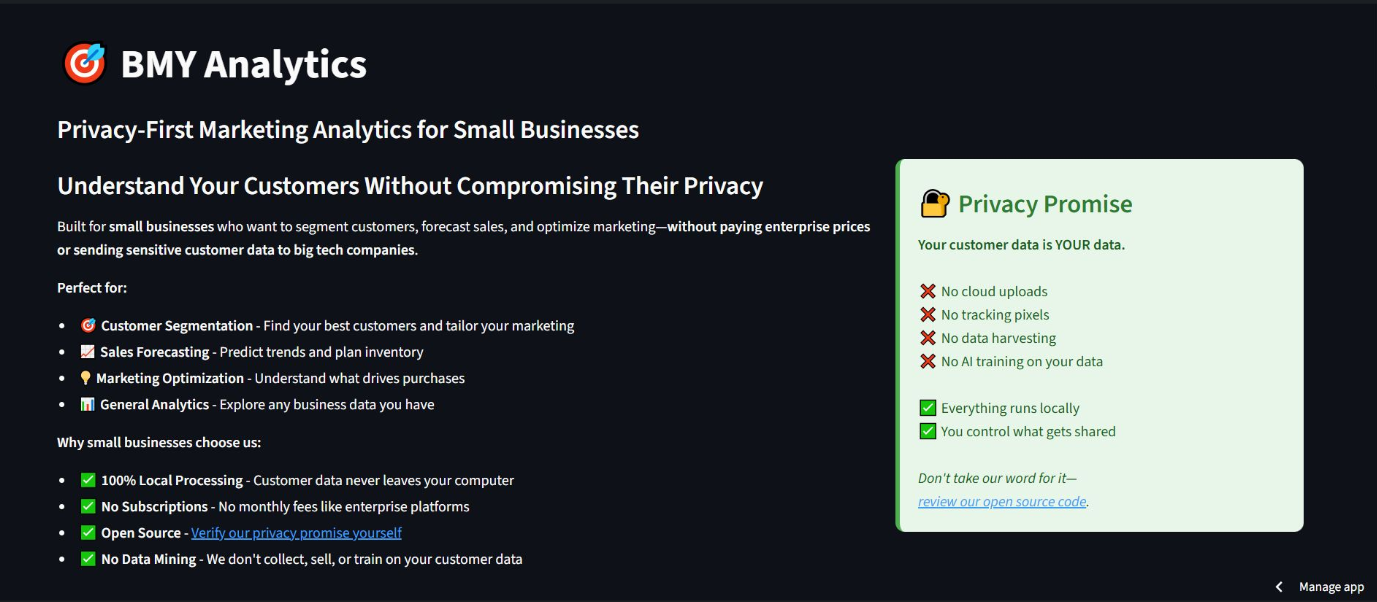
Prefer not to build the spreadsheet by hand? I made a free, private tool that segments your customers automatically — it runs on your own computer, so your data never leaves it. Try the free segmentation tool, or read how to turn segments into personalized marketing.